









Lift Station Degreaser Pros and Cons
Odors and gunky fat buildup aren’t things you want to think about, but with lift stations, they can become an part of daily operations. You want your lift station to be in the best condition possible, so you’ve started to explore floating degreasers. But the question remains: are degreasers right for your lift station, or would another type of treatment better suit your facility?
At State Chemical, we manufacture and distribute chemical solutions for a variety of applications, including floating degreasers for lift station maintenance. When it comes to a vital system like a lift station, you don’t want to mess it up, so understanding the benefits and drawbacks of degreasers is important to you before buying.
To help you determine whether degreasers are right for your lift station, we will explain how degreasers work, their pros and cons, and alternative treatment options. After reading, you’ll know whether lift station degreasers are the right choice for you—and if they’re not, you’ll know which alternatives to explore instead.

How Do Lift Station Degreasers Work?
Floating degreasers are chemicals you add to your lift station’s wet well. Once in the wet well, they float on top of the water, breaking up fats, oils, and greases (FOGs) to prevent them from congealing over the floats or to the lift station walls. Plus, because they cap off the top of the wet well, they seal odors inside, replacing them with more pleasant scents.

Degreasers are primarily used for odor control and to prevent a grease cap from forming over the wet well. They are not used to eliminate lift station pump-outs, but they can reduce them.
Overall, floating degreasers can be very helpful for buildup and odors. But depending on your specific situation, there are different pros and cons.
Pro: Lift Station Degreasers Act as Long-Term, Preventative Treatment

The most significant benefit of degreasers is that they act as a long-term solution. They prevent FOG buildup and odors from getting severe, helping your lift station to stay cleaner and better maintained.
If you continue using degreasers over time, you can ensure that this remains the case. As long as you keep using degreasers and experience no sudden influx of buildup, you can keep your lift station under control.
Con: Lift Station Degreasers Will Struggle to Emulsify Heavy Already-Present FOG Buildup
The downside to floating degreasers is if your lift station already has severe buildup. Because while degreasers are the perfect way to prevent future issues, they will struggle with completely emulsifying heavy FOG buildup.

If you start using degreasers right after a pump-out, this shouldn’t be an issue.
But if you’re looking for a way to clear your buildup right away, use manual removal methods instead.
Pro: Lift Station Degreasers Control Foul Odors

One of the primary benefits of degreasers is how well they control bad smells. Lift stations are, by nature, pretty odorous—after all, they deal entirely with waste. For an easy solution, degreasers cap off odors at the top of the wet well.
This means that malodors are trapped beneath the surface, with the degreaser instead emitting a more pleasant scent. From there, foul odors are less noticeable or even undetectable. This can be a game-changer for lift stations with severe odor problems.
Pro: Lift Station Degreasers Still Work in Extreme Conditions, Unlike Bacterial Treatment Methods
One pro of lift station degreasers is that regardless of the conditions in your lift station, they will continue to work. This makes them a strong alternative if you can’t use bacterial products.

For example, let’s say your lift station can dip into temperatures as low as 20° F in the winter. You want to maintain the system, but the bacteria in biological products will die under these conditions, rendering them ineffective.
In a situation like this, degreasers can act as a strong alternative for preventing FOG buildup. Since they work regardless of the conditions, they can be a great option for situations where conditions may fluctuate.
Alternative Ways to Maintain a Lift Station
If floating degreasers don’t sound like the solution for your lift station, there are other treatment options at your disposal.
Firstly, you can resort to manual FOG removal, such as through skimming. In this process, you would use a tool to skim the top of the wet well and collect built-up FOGs, effectively removing them from the system.
This can be a time-consuming method since you would need to spend at least 30 minutes per week skimming in order to see a significant difference. Over time, this can become tedious, especially as it won’t necessarily be as effective as chemical maintenance.
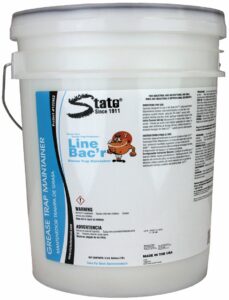
On the other hand, you can also use bacterial products to maintain your lift station. With this process, an automated pump would circulate bacteria through your wet well. From there, the bacteria would consume FOG buildup, digesting it into water and air to pass easily through the sewer system. However, bacteria can only survive under certain conditions, so before buying, you’ll need to ensure that your lift station has livable conditions for bacteria (this means there must be a food source, temperatures of at least 40° F and no more than 120° F, and a pH of 6–9).
Any of these methods can be effective; you can find the right option for you depending on your individual preferences and situation.
Learn About State Chemical’s Lift Station Degreaser Cherry Float™
You know it’s important to take care of your lift station, but it’s not always easy to tell which treatment method is right for you. Now that you know the pros and cons of lift station degreasers, watch the video below to learn about State Chemical’s lift station degreaser Cherry Float™.
Get in Touch With Our Team
Have a question or need support? Our team is here to help. Fill out the form and we’ll connect you with the right expert to get you the answers you need.
For details on how we handle your information, visit our Privacy Policy.