









How Should I Treat Odors in My Grease Trap?
Grease trap smells are stubborn and hard to eliminate if you don’t know the true cause or reason for the problem. Whether it’s a restaurant grease trap, in schools, hotels, or other commercial facilities, you have other priorities that may sit higher on your to-do list. Treating odors for any part of your facility can feel daunting if you don’t know what you’re looking for.
State Chemical has been selling and servicing grease trap treatment chemicals for decades. We understand that your mindset toward your grease trap might be “out of sight, out of mind” until an issue pops up, and it’s hard to figure out what you need when you’re suddenly scrambling for solutions.
In this article, you will learn everything you need to know about treating your grease trap odors. After reading, you’ll be ready to make a well-informed decision about what your grease trap needs in order to get back into prime condition.
Why Does My Grease Trap Smell?
The job of a grease trap is to collect items going down your sink that you don’t want in your drain lines. For example, if you’re running a fast-food restaurant, you probably can’t stop food particles and grease from going down your drains entirely. That’s where the grease trap comes in, limiting the amount of fats, oils, and greases (FOGs) and other items that go down your drain so that your water can keep flowing.

If your grease trap smells, it’s because of the items it’s collecting. Especially if you’re in the food industry, these items are likely FOGs. When items like grease or dairy sit in your grease trap, they will start to rot after a while, and especially as more food collects, this issue will only get worse.
For example, in a place like a school, your cafeteria could be dealing with odors. All kinds of food and hundreds of students bring different items through the door. You are bound to deal with a variety of buildup in your drains that will require your grease traps to put in extra work.
Essentially everything that goes down your drain contributes to buildup, and organics create odors. So, what can you do about this? Pumping and chemical grease trap maintenance are the answer.
How To Get Rid of Grease Trap Odors
Grease traps must be maintained in order to function correctly. If you don’t maintain them, you won’t only be risking bad smells but also backups, clogs, and even rotting pipes. So, how do you maintain grease traps to control odors?
Pump Your Grease Trap
Pumping your grease trap is necessary regardless of any chemical maintenance you may practice. After a while of normal sink usage, organics will build up in your grease trap, and it’ll be too much to wash down your sink. This will lead to foul odors and, eventually, clogs. It’s time for grease trap pumping when your grease trap is about a quarter of the way full.
Solving Grease Trap Odors with Bacterial Maintainers
The most effective way to eliminate odors and prevent future backups is to practice preventative maintenance. Pumping your grease trap is a necessity to physically remove buildup, but you can better control odors, delay the need to pump, and prolong your grease trap’s life by also using a preventative treatment program.
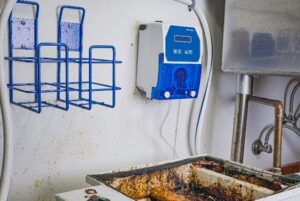
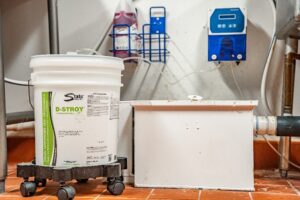
For many State customers, grease trap chemicals are usually set up on a feed pump that dispenses the chemicals as frequently as 24/7. The chemicals then break down buildup in the grease trap and continue to do so all the way through your pipes from that point on.
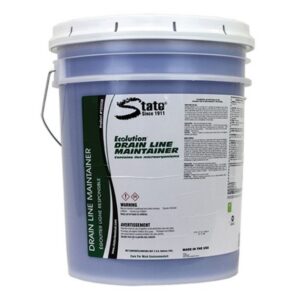
If you use a bacterial maintainer, such as Ecolution® Drain Line Maintainer, the bacteria colony digests FOGs into water and air, lessening buildup. Meanwhile, if you use another maintainer, such as an emulsifier, the buildup will be liquified so that it easily passes through the pipes.
When choosing a grease trap maintainer, just be careful about what kind you choose based on your drain. For standard situations, any type of maintainer should be effective, so your choice will usually be based on specific regulatory requirements and the amount of grease going down the drain.
What Happens If I Don’t Treat My Grease Trap Odors?
The thing is, if you have grease trap odors, it’s indicative of buildup. If you don’t treat the odors, you’re also not treating the buildup.

You may be thinking, “Why should I use chemical maintainers if I already regularly pump my grease trap?” Preventative maintenance will get rid of bad odors that may deter customers, but it will also remove the buildup in your grease trap and help the grease trap operate effectively for longer between pumpouts. All the buildup that gets through the grease trap is likely sitting in your drains, because pumping only cleans out the grease trap.
One customer we worked with pumped out their grease trap regularly but hadn’t used preventative maintainers in years. During the process of setting preventative maintenance up, it was discovered that the business had one long pipe running under their floor, backed up with years of buildup that had gotten through the grease trap. The line started to rot, and hardly anything was coming out at the other end of the pipe.
If this rot had continued, the floor would’ve eventually caved in. Preventative maintenance helps your business avoid the costly and destructive outcome of years of buildup and maintain a healthy grease trap and drain system.
What Should a Healthy Grease Trap Look Like?
So, unhealthy grease traps are odorous and full of buildup. But what does a healthy grease trap look like?
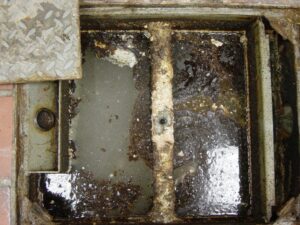
A healthy grease trap should be full of mostly liquid, and when looking at it, you shouldn’t be able to notice any solids. There won’t be any thick layers of grease, and no chunks of food, debris, or hardened buildup. The surface shouldn’t look crusted over, but instead have a very light film.
The water is typically gray or brown. Any dark, milky, or bright-colored water is cause for concern. A healthy grease trap won’t have a strong odor, but a mild smell is normal. A rotten or sulfur smell likely means that there is buildup in the space. The water should be free flowing and show no signs of backing up.
Your Next Step: Pump Your Grease Trap Regularly and Invest in Preventative Maintenance
You wanted to figure out how to treat odors in your grease trap, and now you know that it’s just as much about treating odors as it is about preventing damaging buildup. Your next step is to check out information on treating your grease trap and make the right decision for your facility.
Get in Touch With Our Team
Have a question or need support? Our team is here to help. Fill out the form and we’ll connect you with the right expert to get you the answers you need.
For details on how we handle your information, visit our Privacy Policy.